Most facility problems are found the hard way – a tenant complains, a piece of equipment has already failed, an alarm goes off after the damage is done. IoT monitoring changes the timing. It catches a condition drifting out of range while it is still just a number, before it becomes a work order raised in anger.
We are building sensor monitoring directly into the same platform that manages your work orders – not as a separate app or a separate vendor relationship, but as one connected system. Where it makes sense, we pair our own platform with proven monitoring hardware from established partners, rather than building every layer from scratch. A sensor detects an issue, a work order is generated automatically, and the right technician is notified immediately.
One team, one point of accountability
IoT monitoring is delivered under the same accountability standard as every other Kibog service. You have one point of contact and one team responsible for the outcome – from the sensor reading to the work order to the technician on-site, with nothing handed off between disconnected vendors along the way.
That is what makes this different from a typical sensor vendor relationship: the system is not just software watching a number. It is a defined, accountable process, documented and owned by Kibog from the moment a sensor detects a condition to the moment it is resolved.
How it works
1. Sensors monitor continuously
Wireless sensors track the conditions that matter most in your facility, around the clock, without anyone needing to check in on them.
2. A threshold is crossed
Every sensor has defined limits. The moment a reading moves outside them, the system knows immediately.
3. A work order is created automatically
No one has to notice the alert and open a ticket by hand. The work order is generated with the location, the asset, and the reading that triggered it.
4. It is routed to the right person
The work order is auto-assigned based on location, so it lands with the technician actually positioned to respond.
5. The technician is notified immediately
Email and SMS text message, sent directly to the person responsible. No dashboard-checking required for the alert to reach someone.
What gets monitored
If a piece of equipment in your facility has ever caused a “we found out too late” moment, there is a good chance it can be monitored.
Temperature and cold storage
Refrigeration, walk-in coolers, food safety compliance, server rooms.
Early signs of HVAC or mechanical failure before a full breakdown.
Works over cellular
Reports independent of building WiFi – nothing new for your IT team to configure.
Case study: temperature compliance for food service
One example of this approach in practice – built and run for real clients, not a concept.
Restaurants and food service providers need continuous temperature compliance – walk-in coolers, refrigeration units, and other spaces where a few degrees of drift can mean spoiled inventory or a failed health inspection. Wireless sensors tracked temperature and door open/close status around the clock. If a unit drifted outside a safe threshold, or a door was left open too long, the system generated a real-time email and text alert – and produced a printable, health-department-ready temperature log automatically, removing the need for staff to manually record readings by hand.
The sensors transmitted data over cellular networks via SIM card rather than the building’s own WiFi – so the monitoring worked independently, with no dependency on facility IT infrastructure and nothing new to configure on-site.
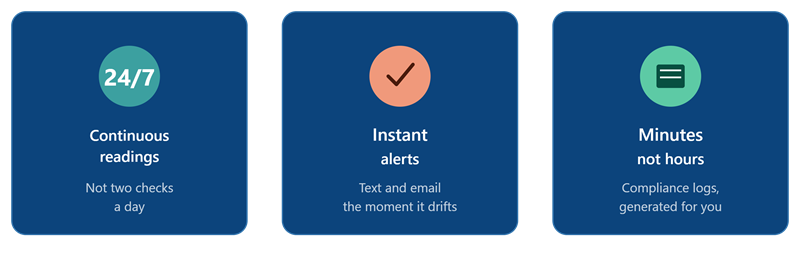
The result: better food safety, less inventory loss from spoilage, and compliance reporting that took minutes instead of hours.
This is one example of where sensor monitoring applies. The same approach works across many facility types – the food service deployment above is illustrative, not the limit of what Kibog’s IoT monitoring supports.
One partner, not a separate hardware vendor
Kibog sources, installs, and manages the sensors and monitoring hardware directly as part of the platform. There is no separate vendor to coordinate with, no second invoice, no second app to check. The same team that dispatches your technicians is the team that reads and acts on the sensor data.
That matters because most IoT monitoring offerings in facility services come from a hardware or software vendor with no field operation behind them – the alert fires, and then it is up to you to find someone to respond. Kibog closes that loop end to end: the sensor, the alert, the work order, and the technician are all one connected system.
IoT monitoring is one part of a broader relationship – most clients pair it with our core multi-trade maintenance and repair services, so the same team monitoring your buildings is also the team dispatched when something needs hands-on attention.
Ready-to-deploy sensor kits
Rather than piecing together individual sensors, most facilities start with one of our pre-configured kits, each built around a specific, high-cost failure point, with thresholds already set for its use case.
Six kits. Configured and ready to alert.
Facility Starter, HVAC Monitoring, Cold Chain Compliance, Water Damage Prevention, Vacant Property Monitoring, and Access & Security. Pick the one that matches your highest-risk spaces, or talk to us if you’re not sure which to start with.