
Commercial fire door with closer hardware and an inspection tag, representing a fire door compliance inspection.

Fire Door Inspection Requirements: How Often the Code Actually Requires

Fire door inspection is one of the more commonly overlooked recurring compliance requirements in commercial buildings, partly because it doesn’t look urgent day to day — a fire door usually still closes and looks fine right up until the moment it’s actually needed and doesn’t perform correctly. How often the code actually requires it, though,

Fire Door Inspection Requirements: How Often the Code Actually Requires Read More »

Technician's toolkit set up for a bundled site visit covering multiple small facility repairs in one trip.

The Bundled Site Visit Program: Clearing a Repair List in One Scheduled Visit

Small facility repairs have an odd property: individually, none of them justify scheduling a dedicated visit. A loose door closer, a scuffed wall, a missing ceiling tile, a wobbly washroom fixture — each one is a five- or fifteen-minute fix, but coordinating a separate truck roll for each one is wildly disproportionate to the job

The Bundled Site Visit Program: Clearing a Repair List in One Scheduled Visit Read More »

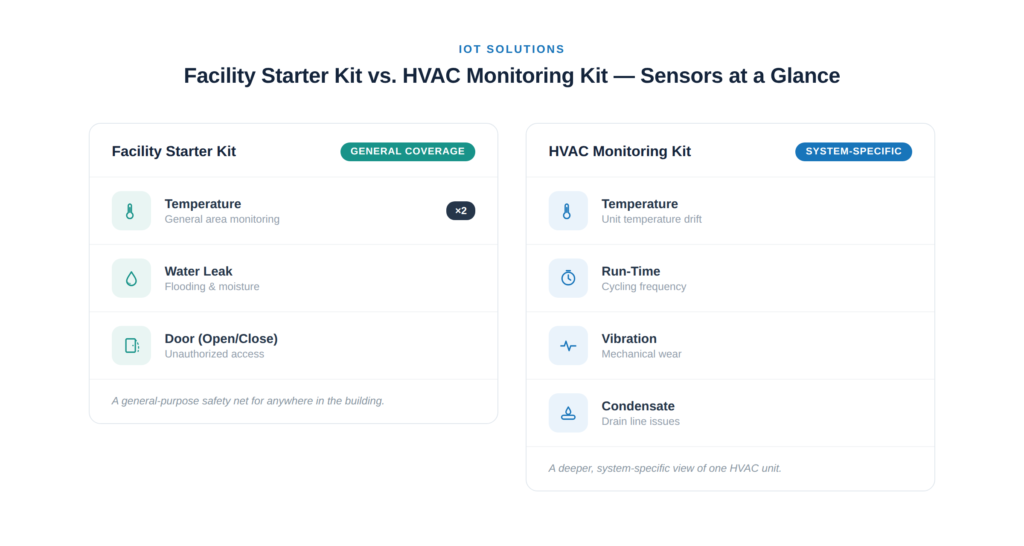
Side-by-side comparison of sensors included in the Facility Starter Kit and the HVAC Monitoring Kit.

Facility Starter Kit vs. HVAC Monitoring Kit: Which Sensors Do You Actually Need First

The two most common starting points when a building adds wireless sensor monitoring for the first time are the Facility Starter Kit and the HVAC Monitoring Kit, and they’re solving different problems — which is worth being clear about before picking one by default just because it’s listed first or sounds more general. The Facility

Facility Starter Kit vs. HVAC Monitoring Kit: Which Sensors Do You Actually Need First Read More »

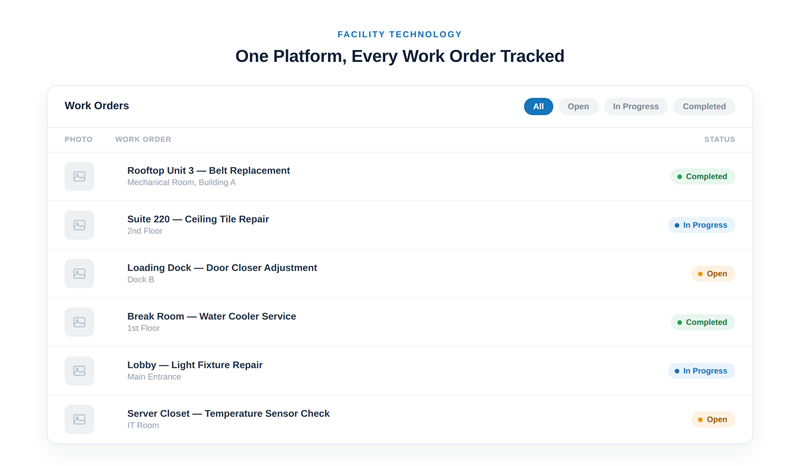
Mockup of a work order tracking dashboard showing job status, photos, and completion notes across multiple buildings.

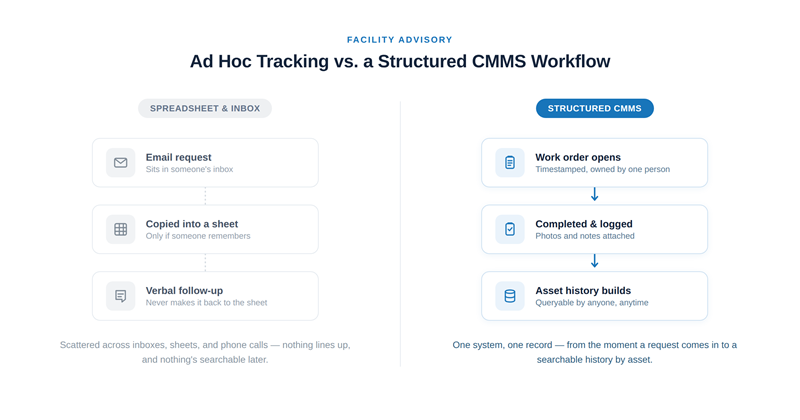
What “Powered by Our Technology Platform” Actually Means for Work Order Tracking

“Powered by our technology platform” is one of those phrases that can mean almost anything, so it’s worth being specific about what it actually covers for Kibog: every work order — status, photos, and completion notes — tracked in one system, for every building in a portfolio, instead of scattered across email threads, text messages,

What “Powered by Our Technology Platform” Actually Means for Work Order Tracking Read More »

Facility maintenance technician logging a completed preventative maintenance inspection on a tablet in a mechanical room.

What “CMMS-Compatible” Actually Means for a Preventative Maintenance Program

“CMMS-compatible” gets used as a checkbox on a lot of vendor questionnaires, and it usually means something narrower than facility managers expect. It doesn’t mean a vendor built their own software and wants you on it. It means the vendor’s preventative maintenance program adapts to whatever system you’re already running — logging completed work, timestamps,

What “CMMS-Compatible” Actually Means for a Preventative Maintenance Program Read More »

Facility manager reviewing a consolidated multi-trade work order

Multi-Trade vs. Single-Trade Vendors: What Actually Changes for a Facility Manager

Most facility portfolios accumulate vendors one problem at a time. An electrician gets hired for a panel issue. An HVAC company comes in for a compressor repair. A plumber shows up for a leak. Two years later, a facility manager is coordinating five or six separate relationships, each with its own scheduling process, invoicing, and

Multi-Trade vs. Single-Trade Vendors: What Actually Changes for a Facility Manager Read More »

Facility services technician arriving on site for an emergency response call

What a Real Emergency Response Time Commitment Actually Looks Like

Almost every facility services company advertises “fast response” or “24/7 availability.” Almost none of them attach an actual number to that promise, or explain what happens if they miss it. The gap between a marketing phrase and an enforceable commitment is exactly where facility managers get burned, usually at the worst possible moment. What “Fast”

What a Real Emergency Response Time Commitment Actually Looks Like Read More »

Wireless sensor with battery compartment open showing replaceable battery

Sensor Battery Life: What Actually Drains It and How Long Kits Really Last

One of the most common practical questions about wireless sensors, and one that gets a frustratingly vague answer from most manufacturers, is simply: how long does the battery actually last. Spec sheets often list an optimistic best-case number that rarely matches reality. Here’s what actually determines real-world battery life, and how to plan maintenance around

Sensor Battery Life: What Actually Drains It and How Long Kits Really Last Read More »

Completed facility maintenance work order with photos and documented findings

What “Documented Work” Should Actually Include on a Completed Job

Ask ten facility services vendors what “documentation” means and you’ll likely get ten different answers, ranging from a text message saying “all fixed” to a genuinely useful record that holds up for audits, warranty claims, and future maintenance planning. The word gets used loosely enough that it’s worth being specific about what a complete job

What “Documented Work” Should Actually Include on a Completed Job Read More »

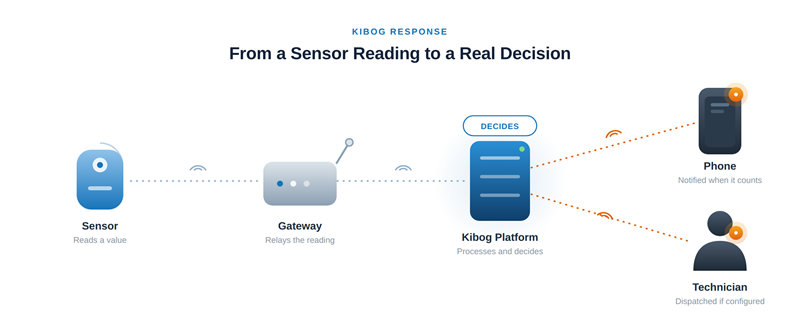
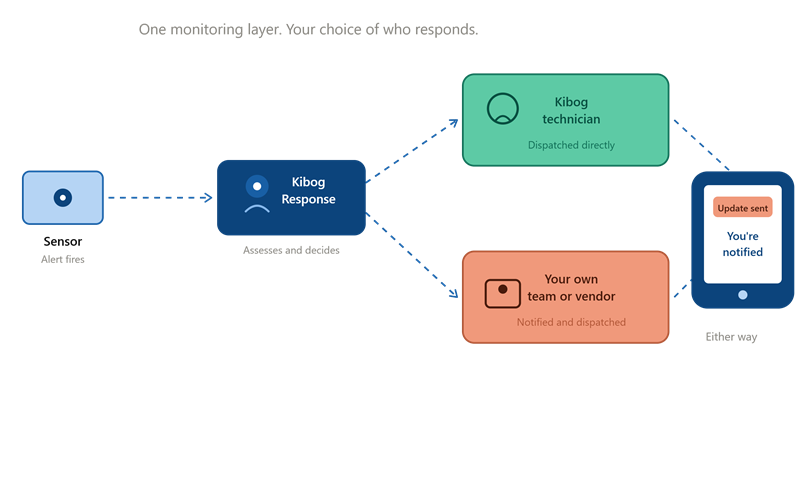
Diagram showing Kibog Response monitoring dispatching to either a Kibog technician or the client's own existing maintenance team

What Happens When Kibog Response and Your Existing Facility Team Work Together

A common hesitation when a facility manager considers Kibog Response: “we already have an internal team and existing vendors, does this mean replacing them?” The honest answer is no, and it’s worth walking through exactly how the two work together in practice, since this comes up in nearly every early conversation. What Kibog Response Actually

What Happens When Kibog Response and Your Existing Facility Team Work Together Read More »

Comparison of sensor installation in an existing retrofit building versus new construction

Retrofit vs. New Construction: Where Sensor Installation Actually Differs

Sensor monitoring gets planned very differently depending on whether it’s going into a building that’s already operating versus one still under construction. The constraints, timing, and even the hardware choices genuinely differ. Here’s what actually changes between the two scenarios. Retrofit: Working Around What Already Exists Connectivity is a bigger question mark. An existing building’s

Retrofit vs. New Construction: Where Sensor Installation Actually Differs Read More »