An HVAC unit rarely fails without warning. Compressors run hotter than normal for days before they fail outright. Airflow degrades gradually as filters clog. Refrigerant leaks slowly before a system loses cooling capacity entirely. The warning signs exist, the problem is that almost nobody is watching for them until the unit stops working and occupants start complaining.
This is the gap IoT sensors are built to close. For a broader look at how monitoring fits into a facility management strategy, see our IoT Solutions page.
What Actually Fails, and What It Looks Like Before It Fails
Compressor strain. Before a compressor fails outright, it often runs longer cycles trying to reach the same setpoint, or runs hotter than its normal operating range. A temperature sensor tracking the unit’s output over time will show this drift well before a technician would notice it on a routine visit.
Airflow degradation. A clogged filter or failing fan motor reduces airflow gradually. Occupants usually notice this as “it feels stuffy in here” long before it becomes a full system failure, but by the time that complaint reaches facilities, the underlying issue has often been building for weeks.
Refrigerant loss. Slow leaks cause a system to work harder for the same output, which shows up as extended run times and higher energy consumption before it shows up as a total loss of cooling.
Water damage from condensate lines. HVAC condensate drain lines clog more often than most facility managers expect, and a clogged line backing up onto a ceiling tile or into a mechanical room is a completely preventable and completely common failure.
Why Preventative Maintenance Alone Doesn’t Catch This
Scheduled preventative maintenance checks a unit on a calendar, monthly, quarterly, whatever the schedule dictates. The problem is that failures don’t wait for the schedule. A unit that starts drifting the week after a routine inspection won’t get looked at again until the next scheduled visit, which could be weeks or months away.
IoT monitoring doesn’t replace preventative maintenance. It fills the gap between visits, catching the drift that starts on day three of a 90-day maintenance cycle, not just what’s visible on inspection day.
What Actually Gets Monitored
For HVAC-specific monitoring, the highest-value sensor points are:
- Supply and return air temperature, to catch efficiency loss before it becomes a full failure
- Condensate pan or drain line moisture sensors, to catch clogs before they cause water damage
- Run-time tracking, to flag units that are cycling more than their historical baseline
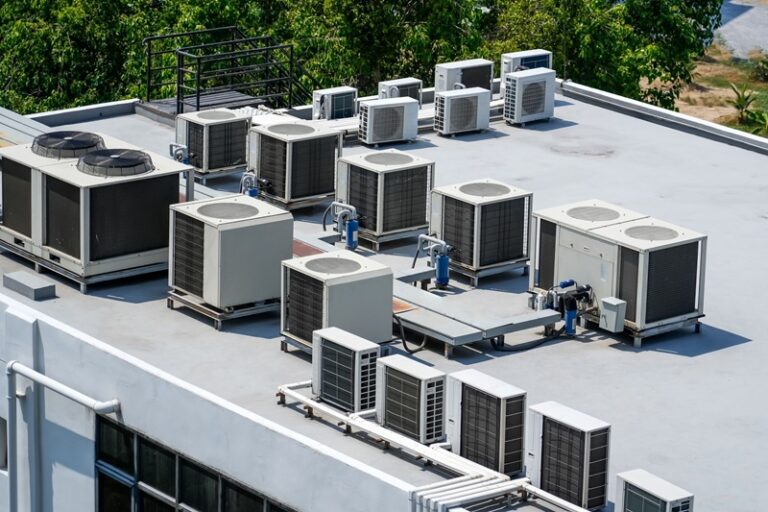
- Vibration sensors, to catch abnormal vibration that signals bearing wear, imbalance, or a mounting issue, stress that damages the unit and, over time, the roof structure beneath it
- Rooftop or mechanical room ambient temperature, especially in facilities with multiple units where one failing unit can be hard to isolate quickly
For a deeper look at protecting mechanical rooms and equipment spaces specifically from water-related failures, see our article on water leak sensors for commercial buildings.
The Real Value Isn’t the Alert. It’s the Lead Time.
A sensor that tells you a unit has already failed is only marginally more useful than an occupant complaint. The value of IoT monitoring is the lead time it buys, days or weeks of warning instead of zero. That lead time is what lets a facility team schedule a repair during normal business hours instead of an emergency after-hours callout, and it’s the difference between a $400 repair and a $4,000 emergency replacement.
Kibog’s HVAC Monitoring Kit is built specifically around this early-warning use case, temperature, run-time, and vibration tracking configured to flag drift before it becomes a failure, not just confirm what already broke.
Ready to stop finding out about HVAC problems from occupant complaints? Explore our sensor kits or talk to our team about your specific system.
Explore more: IoT Solutions