Most conversations about facility monitoring focus on the sensor and the alert itself, what triggers it, how sensitive the threshold is, how fast the notification arrives. Less attention goes to what actually happens in the minutes immediately after an alert fires, even though that window is usually what determines whether the situation stays minor or becomes expensive.
Here is a realistic walkthrough of what a well-run response process actually looks like, minute by minute.
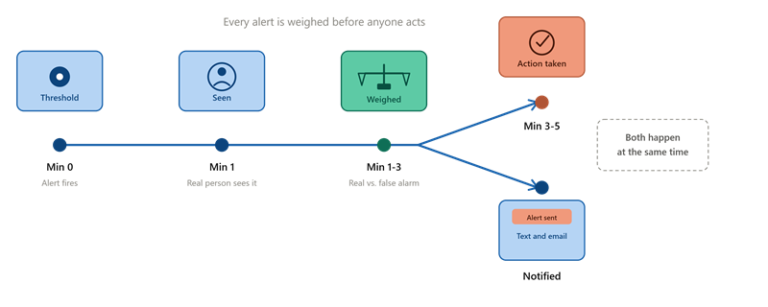
Minute 0: The Threshold Is Crossed
A sensor reading moves outside its defined limit, a walk-in cooler climbing above its safe temperature, a water sensor detecting moisture, a door opening after hours. The alert generates immediately, with no delay for batch processing or scheduled checks.
Minute 1: A Real Person Sees It
This is the step that separates genuine monitoring from a sensor quietly logging data nobody watches. The alert needs to actually reach a person capable of acting on it, not sit in a queue or an inbox waiting to be noticed. For a deeper look at why this distinction matters, see our piece on the gap between having sensors and being protected.
Minutes 1 to 3: Assessment
Not every alert requires the same response. A brief door-open event during a known delivery window is different from the same alert at 3am on a Sunday. This is where a real person’s judgment matters, distinguishing a genuine problem from a false positive or an expected, harmless event, based on context a purely automated system doesn’t have.
Minutes 3 to 5: A Decision Is Made and Acted On
Depending on the assessment, this branches into one of two paths: the situation needs someone dispatched physically, or it needs to be logged and the client notified without further action. Either way, this is the point where the response actually happens, not just the detection.
Simultaneously: The Client Is Notified
This does not wait until the situation is resolved. The client receives a text and email notification the moment a decision is made about the alert, what was detected, and what is being done about it. Nobody should be surprised after the fact that something happened at their facility.
Why This Timeline Matters
For failure modes that compound quickly, water intrusion, temperature failures in cold storage, equipment left running unattended, the difference between a 5-minute response window and a “someone will look at it in the morning” response window is often the difference between a minor inconvenience and a significant loss. 24/7 monitoring that cannot execute this timeline consistently, including at 3am on a weekend, is not actually delivering the protection the phrase implies.
This is the specific process Kibog Response is built around, not just detecting a problem, but moving through assessment, decision, and notification within minutes, every time, regardless of what hour it happens.
Curious what this would actually look like for your facility’s specific risks? Talk to our team.
Explore more: Kibog Response