
Fire Door Inspection and Compliance
Monthly or annual fire door inspection – documented, photo-verified, and ready for an inspector or insurer at any time, wherever your building is.
Fire doors are inspected regularly. Most buildings can’t prove it.
Any door in a fire separation carries a real, ongoing inspection obligation – the specific requirement depends on where the building is. In the US, NFPA 80 requires annual fire door inspection, adopted by reference through the International Building Code and NFPA 101. In Ontario, O. Reg. 213/07 sets a monthly inspection requirement under Article 2.2.3.4(4), with active maintenance obligations under Article 2.2.3.2 – fusible links intact, hardware lubricated, mechanisms adjusted, hold-open devices working. Fire dampers and stop flaps carry their own inspection schedule under Article 2.2.3.5.
Every commercial, institutional, industrial, and multi-residential building carries some version of this obligation. Compliance is widely inconsistent, and a fire door deficiency is one of the more routine citations an inspector writes up. The gap usually isn’t a lack of awareness – it’s the absence of a documented, repeatable process behind the requirement.
What the program includes
Per-door digital register
Photos, timestamps, deficiency status, and year-over-year history for every fire door assembly in the building – not a paper checklist.
Deficiency remediation, same vendor
An issue found during inspection is quoted and completed by the same team – not a second procurement process with a different company.
Audit-ready reporting
A clear, exportable record ready to hand to a fire inspector or insurer at any time – not assembled after the fact under time pressure.
What the register looks like
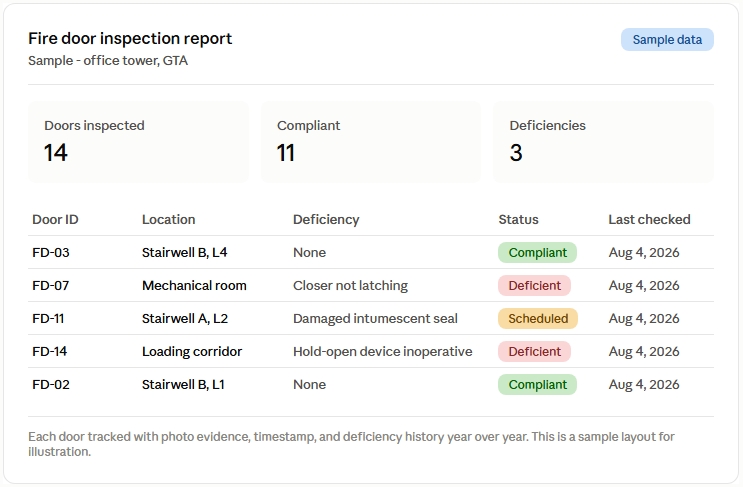
Sample layout shown for illustration – not data from an active inspection.
Why the register matters more than the inspection
A single inspection is a snapshot. The value is in what accumulates over time – a documented, dated history for every door assembly that shows a pattern, not just a point-in-time pass or fail. That history is what an insurer wants to see, what a fire inspector recognizes as a genuine compliance program rather than a one-off checklist, and what protects the building when a question comes up months or years later about when a specific door was last verified.
Who this is for
Property and facility managers responsible for a building’s fire code compliance – particularly long-term care and retirement homes, school boards, hospitals and clinics, post-secondary campuses, and older office towers, where door count and regulatory exposure are both high. Also a fit for any commercial, institutional, industrial, or multi-residential building that has never had a formal, documented fire door inspection program in place.
Frequently asked questions
Is fire door inspection actually required by law?
Yes, in most jurisdictions. In the US, NFPA 80 requires annual fire door inspection for doors in a fire separation. In Ontario, O. Reg. 213/07, Article 2.2.3.4(4) requires monthly inspection, with active maintenance obligations under Article 2.2.3.2. The specific code and frequency depend on where your building is located.
What happens if a deficiency is found?
It’s logged in the register with a clear status, quoted, and remediated as part of the same relationship – no separate vendor or second procurement process required.
Can we get a copy of our compliance record for an inspector or insurer?
Yes – the per-door register is built to be handed over directly, with photo evidence and dated history, at any time it’s requested.
Related
🔧 Doors and Hardware
Repair, replacement, and installation for commercial doors, frames, and hardware. Explore doors and hardware
🚪 All Door Services
See every door-related service Kibog offers. View all door services
Get your fire doors on a documented schedule
Tell us about your building and door count – we’ll follow up within one business day.