
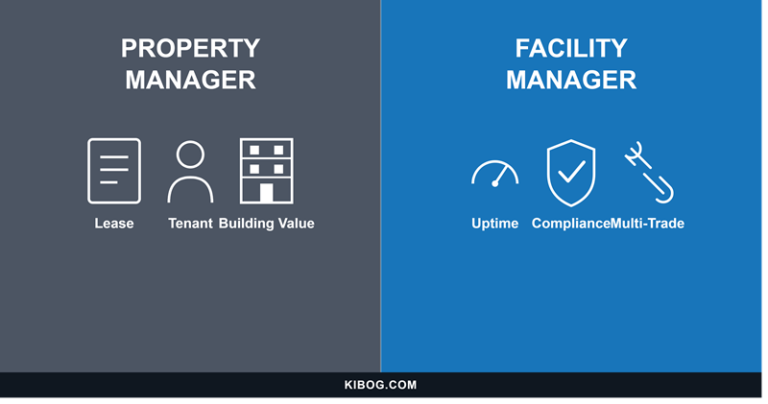
If you have ever sat in a vendor pitch meeting wondering why the conversation felt slightly off — like the vendor was answering questions nobody asked — there is a good chance the mismatch was this: they were pitching to a property manager, and you are a facility manager. Or the reverse.
The two roles get used interchangeably in casual conversation. They are not the same job, and the difference matters enormously when you are the one deciding which vendor gets the contract.
What a Property Manager Actually Owns
A property manager works on behalf of the building’s owner or landlord. Their job is the building as an asset — leasing, tenant relations, rent collection, and protecting the owner’s return on that piece of real estate. When a property manager calls a vendor, the underlying question is usually some version of: does this protect the building’s value and keep tenants happy without costing the owner more than necessary?
Property managers are the primary buyer for a huge share of commercial real estate — but they are not the only buyer, and for a specific and growing category of building, they are not the buyer at all.
What a Facility Manager Actually Owns
A facility manager works on behalf of the organization occupying the space — not the landlord. If a company leases three floors of an office tower, the facility manager is responsible for how those three floors function for the business that works in them: uptime, safety, operational continuity, and the physical environment employees and operations depend on.
This is a different job with different pressures. A facility manager measures success in things like maintenance ratios, asset lifecycle, vendor accountability, and documentation that satisfies compliance or audit requirements — particularly in healthcare, manufacturing, and any regulated environment. When a facility manager calls a vendor, the underlying question is usually: can this vendor be trusted with the operational continuity of my organization, and will they document it well enough that I am covered when someone asks.
Why This Difference Changes What “Good Vendor” Means
A vendor who is excellent for a property manager can be a poor fit for a facility manager, and vice versa. Here is where that shows up in practice.
Documentation standards. Property managers care that the work got done and the tenant is not complaining. Facility managers — especially in healthcare, manufacturing, and government — need photo documentation, asset-level history, and completion reports that would satisfy an auditor. Multiple facility vendors without a shared documentation standard is a genuine operational risk for a facility manager in a way it usually is not for a property manager.
Multi-trade coordination. A property manager overseeing one building might be fine calling different vendors for different trades — it’s manageable at that scale. A facility manager overseeing multiple locations across a region is coordinating trades constantly, and the qualities that matter in a multi-site partner — consistency, single point of accountability, standardized reporting — become non-negotiable rather than nice-to-have.
Response time commitments. A property manager wants a repair done reasonably fast so a tenant doesn’t complain. A facility manager in a healthcare or manufacturing environment may have an actual operational or safety consequence tied to response time, which means the vendor relationship needs a confirmed SLA, not a best-effort promise.
Budget conversations. Property managers often operate against a building-level operating budget tied to NOI (net operating income) targets set by the owner. Facility managers often operate against a departmental or corporate maintenance budget, and increasingly need to show leadership that reactive spend is trending down — which is exactly why the real cost of reactive maintenance is a conversation facility managers care about more directly than most property managers do.
Why Kibog Built for Facility Managers First
Kibog works with both personas — property managers remain an important part of our client base — but our primary focus, our documentation platform, and our service model are built around what facility managers actually need: multi-trade coordination under one accountable vendor, a work order platform that produces the asset history and reporting a facility manager can hand to their own leadership, and response time commitments that hold up in operationally serious environments.
If you are a facility manager evaluating vendors across Charlotte, Atlanta, Nashville, or anywhere in the Southeast, that distinction is worth naming out loud in your first conversation with any potential partner — it will tell you quickly whether they understand the job you actually have.
Kibog provides multi-trade facility services across the Southeast USA, purpose-built for facility managers who need one accountable partner and documentation they can rely on. If you’re evaluating your current vendor setup, our Advisory team can also help you think through what “good” looks like for your specific portfolio. Get in touch or call 1-866-526-8819.