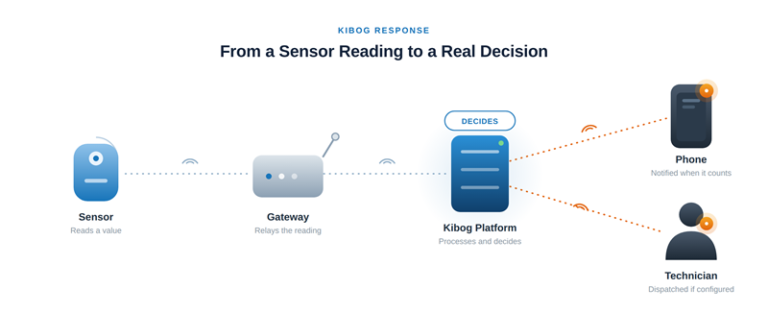
A wireless sensor doesn’t know what an emergency is. It reads a value — a temperature, a door state, the presence of water — and reports it. Whether that reading means “someone should be dispatched right now” or “log it and move on” is a decision, and that decision is where a lot of monitoring services quietly fall short: they forward every reading as a raw alert and leave the facility team to sort out which ones actually matter, at whatever hour the reading happens to arrive.
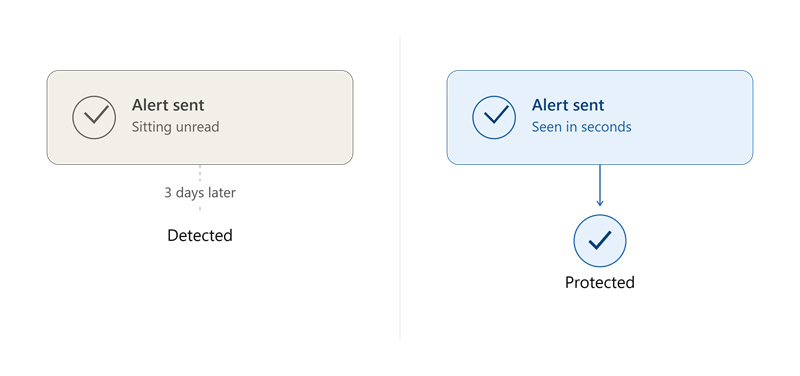
That gap is easy to underestimate until it’s lived through once. A facility manager who signs up for sensor monitoring expecting peace of mind can end up with the opposite — a phone that buzzes at 11 p.m. because a walk-in cooler door was propped open for two minutes during a delivery, indistinguishable in the notification from an actual compressor failure. After a few weeks of that, most people do the predictable thing: they start ignoring the alerts, or muting the app entirely. At that point the monitoring system is worse than useless, because it’s created a false sense of coverage while nobody’s actually watching.
That decision layer is what the Kibog Platform is actually for. Sensor data arrives from the gateway, gets evaluated against the thresholds and context that were configured for that specific location, and a determination gets made — this is noise, this is worth a note, or this requires dispatch now. Context matters more than the raw number here: a two-minute door-open reading during a known delivery window reads very differently than the same door state at 3 a.m. with no scheduled activity, even though the sensor is reporting the identical thing in both cases. Building that context in per location is exactly the work a generic notification pipeline skips, because it’s easier to just forward everything and let the humans on the other end sort it out.
Kibog Response is built around that middle step being real, not automated on the decision side, so a false-positive reading doesn’t turn into a 2 a.m. phone call, and a genuine problem doesn’t sit in a queue behind noise that never should have been escalated in the first place. Automation still does real work in this chain — the sensor reading, the transmission through the gateway, the initial threshold check — but the judgment call about whether a specific reading, in a specific context, actually warrants waking someone up or sending a technician is not treated as something a script can fully own.
This is also the practical difference between a monitoring service and a notification app, and it’s worth naming plainly because the two get marketed almost identically. A notification app tells you a threshold was crossed. That’s it — the responsibility for figuring out what it means and what to do about it lands entirely back on the facility manager, at whatever time of day or night the alert happens to fire. A monitoring and dispatch relationship tells you that a threshold was crossed, evaluates whether it’s worth acting on given the actual context, and — when it is — gets someone moving on it, day or night, without the facility manager having to be the one triaging alerts from bed.
There’s a trust dimension to this that compounds over time. The first time a system correctly ignores a false positive instead of escalating it, that’s a small, invisible win — nothing happened, which is exactly the point. The first time it correctly catches something real and gets a technician moving before the facility manager even knew there was a problem, that’s the moment the relationship actually earns its keep. Systems that get the evaluation step wrong in either direction — too much noise or missed real events — don’t get a second chance to build that trust; people stop believing the alerts either way.
The hardware side of that chain — the sensors and gateways doing the actual reading — is covered separately on IoT Solutions, which is worth a look for anyone who doesn’t have sensors in place yet and is trying to understand what the monitoring layer sits on top of. The two are designed to work together: the hardware generates accurate readings, and Response is what turns those readings into the right action at the right time, instead of just another notification competing for attention in an already-crowded phone.
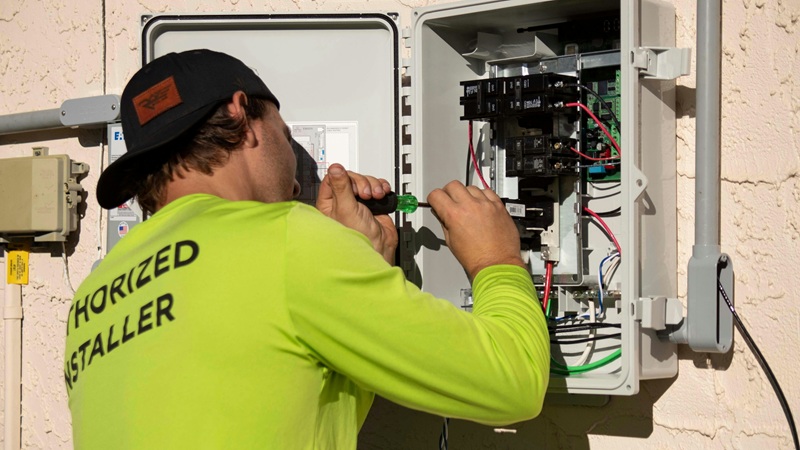
Configuration is where a lot of that context actually gets built, and it happens before a single sensor ever fires an alert that matters. Setting up monitoring for a new location isn’t just mounting sensors and connecting a gateway — it’s establishing what “normal” looks like for that specific building: expected delivery windows for a cooler door, typical occupancy patterns for a secure entrance, seasonal temperature ranges that would be unremarkable in summer but alarming in winter. That configuration work is what lets the evaluation layer make a genuinely informed call later, rather than applying a one-size-fits-all threshold to every building regardless of how it actually operates.
It’s also worth addressing directly what happens when the evaluation gets it wrong — because no system, human-reviewed or not, is going to have a perfect record. The design goal isn’t zero errors; it’s a system that’s transparent about what happened and improves the thresholds and context it’s working from over time, rather than a black box that either floods a facility manager with alerts or silently drops something that mattered. A facility manager should be able to ask why a particular reading was or wasn’t escalated and get a real answer, not just a shrug.