
The two most common starting points when a building adds wireless sensor monitoring for the first time are the Facility Starter Kit and the HVAC Monitoring Kit, and they’re solving different problems — which is worth being clear about before picking one by default just because it’s listed first or sounds more general.
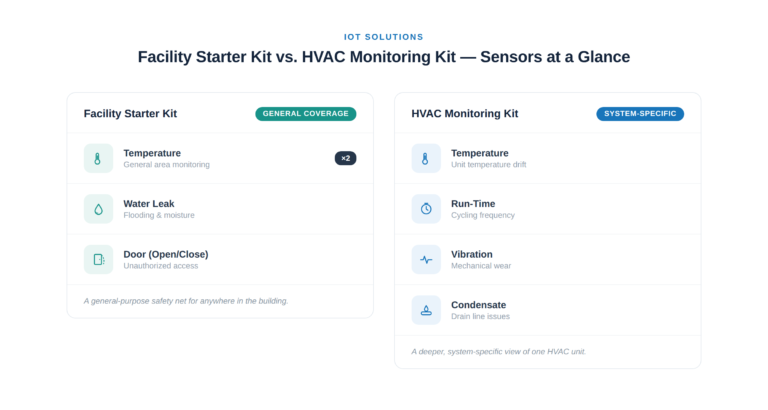
The Facility Starter Kit is built around general building risk: two temperature sensors, a water leak sensor, and a door open/close sensor. It’s the right starting point for a building whose biggest exposure is broad rather than concentrated in one system — a mechanical room that could flood without anyone noticing until the damage is significant, a server or IT closet that could overheat and take down equipment, a secure door that shouldn’t be propped open but sometimes is during a busy shift change. None of those four sensor types is aimed at one specific piece of equipment. They’re a general-purpose safety net for the kinds of failures that can happen almost anywhere in a building and tend to go unnoticed the longest, because nobody’s specifically watching for them between scheduled walkthroughs.
The HVAC Monitoring Kit is narrower and deeper on one system specifically: temperature, unit run-time, vibration, and condensate monitoring, aimed at catching HVAC failures before they become a comfort complaint or a full system replacement. Each of those four readings catches a different failure mode. Temperature drift on its own can mean a dozen things. Run-time tracking is the one that catches a surprising amount on its own — a unit cycling far more frequently than its normal pattern is often the first measurable sign of a failure that’s still weeks away from being obvious to anyone walking past it or feeling a difference in the space. Vibration monitoring picks up mechanical issues — a failing bearing, an imbalance — well before they become audible or before the unit trips offline entirely. Condensate monitoring catches drain line issues before they turn into water damage, which is its own separate failure mode that has nothing to do with the compressor or the coils.
The practical way to choose isn’t about which kit has more sensors or sounds more sophisticated — it’s about which failure mode actually keeps you up at night. If the concern is diffuse — “something bad could happen somewhere in this building and we won’t know until it’s expensive,” without a specific system in mind — start with the Facility Starter Kit, because its value is in covering the blind spots that don’t belong to any one system. If the concern is specific — “our HVAC system is aging, a major unit is past its expected service life, and a failure during a heat wave or cold snap would be disruptive or costly,” — the HVAC Monitoring Kit is the more targeted first move, because it’s built to surface exactly that kind of gradual mechanical decline before it becomes a full outage.
It’s worth being direct about what neither kit does: they’re not a substitute for the preventative maintenance program itself. Sensors surface problems earlier and provide a data trail; they don’t replace scheduled inspections, filter changes, or the hands-on work that keeps equipment running. The two are complementary — a well-maintained unit that’s also monitored gives you both the lower baseline failure rate that comes from good maintenance and the early warning that comes from continuous readings, instead of relying on either one alone.
Neither kit is exclusive, and most buildings that start with one eventually add the other once the first is proven out and the facility team has a working relationship with how the alerts and dispatch process actually function day to day. Starting narrow and expanding is a reasonable, low-risk way to evaluate whether sensor monitoring earns its place in a building’s operations before committing to broader coverage.
Either kit pairs with Kibog Response for continuous monitoring and dispatch once the sensors are in place — the hardware reads the problem, Response decides what to do about it, and the facility team gets a work order or a phone call instead of a raw data feed they’d have to monitor themselves.
Installation for either kit is designed to be minimally disruptive, which matters for facility teams weighing whether sensor monitoring is worth the operational hassle to set up. Wireless sensors mean no new wiring runs through finished ceilings or walls, and a gateway typically covers an entire mechanical room or several nearby spaces on its own wireless range, so a building doesn’t need a sensor-by-sensor wired connection back to a central point. That’s a meaningful difference from older wired monitoring systems, where the installation cost and disruption alone were often enough to make a facility team decide monitoring wasn’t worth pursuing.
Cost is also worth addressing honestly, without attaching numbers that vary by building size and configuration: the Facility Starter Kit is the lower entry point of the two, both in sensor count and in scope, which is part of why it’s a common first step for a facility team that wants to evaluate whether monitoring earns its place before expanding further. The HVAC Monitoring Kit’s more targeted, deeper sensor set reflects its narrower focus on one system rather than broad building coverage. Either way, the decision is better framed around which failure mode actually matters most for a specific building than around which kit costs less on paper.