
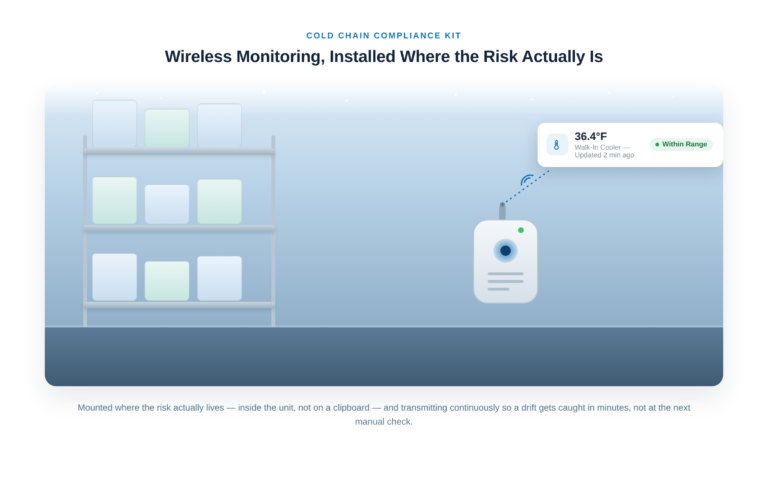
A manual temperature log — someone walking to a walk-in cooler twice a day with a clipboard — has a structural problem that has nothing to do with how conscientious the person doing it is: it only captures two data points a day, and it’s silent about the other twenty-two hours. If a compressor fails at 11 p.m., a 6 a.m. and 6 p.m. check schedule won’t catch it until product has already been sitting out of range for most of a shift, and by the time anyone knows, the decision isn’t “how do we prevent this” — it’s “how much did we just lose.”
There’s also a documentation problem that sits underneath the coverage gap. A clipboard log is only as reliable as the discipline behind it, and it’s an open secret in food service that some manual logs get filled in retroactively — a busy shift means the 2 p.m. check gets written down at 4 p.m. from memory, or worse, backfilled the next morning to avoid a gap in the record. None of that is necessarily dishonest in intent, but it means the record itself can’t be fully trusted even when the temperatures were actually fine, because there’s no way to verify after the fact whether a reading was captured in real time or reconstructed later.
HACCP-style temperature logging is built around continuous, timestamped records instead — every reading captured automatically, not sampled twice a day, and time-stamped in a way that can’t be backfilled or adjusted after the fact. That distinction is the entire point of “HACCP-ready” as a standard: it’s not about the temperature being within range, it’s about being able to prove, with a real record, that it stayed within range continuously, not just at the two moments someone happened to check.
The Cold Chain Compliance Kit is built for exactly that: continuous temperature monitoring paired with door open/close sensing, so a facility gets both the temperature trend and the context for what caused a spike — a door left open during a busy delivery, a routine defrost cycle that temporarily raises the reading, or an actual equipment failure that needs a technician. That context matters because not every temperature spike is the same problem, and a facility manager reviewing a log benefits enormously from knowing which spikes were explainable and routine versus which ones indicate something is actually wrong with the unit.
This matters most for restaurants, food service operations, and pharmaceutical cold storage, where a temperature excursion isn’t just an inventory loss — it’s a compliance and safety issue with a documentation requirement attached, and the requirement doesn’t go away just because nobody happened to be watching when the failure occurred. Continuous logging produces exactly the kind of timestamped record an inspector or auditor is looking for, generated automatically instead of reconstructed after the fact from memory or approximated from a clipboard that may or may not reflect what actually happened.
There’s a cost-avoidance angle worth being specific about, without inventing numbers that don’t apply to any particular facility: the value of catching a compressor failure at 11 p.m. instead of at 6 a.m. isn’t abstract. It’s the difference between a repair call and a full inventory loss, and for many food service operations, a single walk-in cooler represents a meaningful share of total product on hand at any given time. Early detection doesn’t guarantee zero loss, but it consistently means less loss than discovering the problem on the next scheduled check.
Paired with Kibog Response, an out-of-range reading doesn’t just sit in a log waiting to be reviewed the next morning — it triggers a real evaluation and, when warranted, dispatch, so a compressor failure gets caught in the first hour instead of the next shift change. The monitoring and the documentation aren’t separate benefits; they’re the same continuous record serving two purposes at once — compliance evidence when it’s needed, and an active trigger for intervention before the loss compounds.
Audit readiness is worth calling out specifically, since it’s often the moment this kind of monitoring proves its value in a way that’s easy to underestimate beforehand. When a health inspector or a corporate food-safety auditor asks for temperature records, the difference between producing a complete, continuous, timestamped export in a few minutes and reconstructing a partial picture from clipboard logs and memory is significant — not just in how the audit goes, but in how much staff time gets pulled away from actual operations to assemble records that should have already existed in a usable form.
It’s also worth being clear about what this kit doesn’t replace. Staff still need to follow proper food handling and storage procedures — continuous monitoring catches equipment failures and environmental drift, it doesn’t substitute for handling practices, and it isn’t a claim that a facility is automatically HACCP-certified simply by having sensors installed. What it does is remove the biggest structural weakness in a manual-only approach — the blind spot between checks — and produce the kind of record that supports a HACCP-aligned program rather than being a HACCP program on its own. For a closer look at why manual logging falls short even when it’s done diligently, see our post on replacing manual logs with automated monitoring.