“24/7 monitoring” is one of the most common phrases in facility technology marketing, and one of the least precisely defined. It sounds like a complete promise, someone is always watching, all the time. In practice, the phrase covers a wide range of actual service levels, and the gap between what it implies and what it delivers is exactly where facilities get caught out.
What “24/7” Actually Needs to Include
For 24/7 monitoring to mean something real, it needs to answer three separate questions, and a lot of services that use the phrase can only really answer one of them.
Is someone actually watching, or is a system just running? A sensor sending data to a server around the clock is not the same as someone watching that data around the clock. Plenty of “24/7 monitoring” is really “24/7 data collection with business-hours review,” which is a materially different and weaker service, even though both get described with the same phrase.
Can that person actually do anything when something fires? Monitoring that ends at “we saw the alert” is only half the service. If a 2am alert results in an email notification and nothing else, the monitoring existed, but nothing was actually responded to. For a discussion of exactly this gap, see our related piece on the gap between having sensors and being protected.
Is there backup coverage, or is this one person’s job? A monitoring service that depends entirely on a single person being available is not genuinely 24/7, it is availability-dependent, and it has exactly the same single point of failure as an internal team relying on one person to check a dashboard.
Questions Worth Asking Before You Believe the Claim
If a vendor or service provider advertises 24/7 monitoring, a few direct questions clarify what is actually being offered:
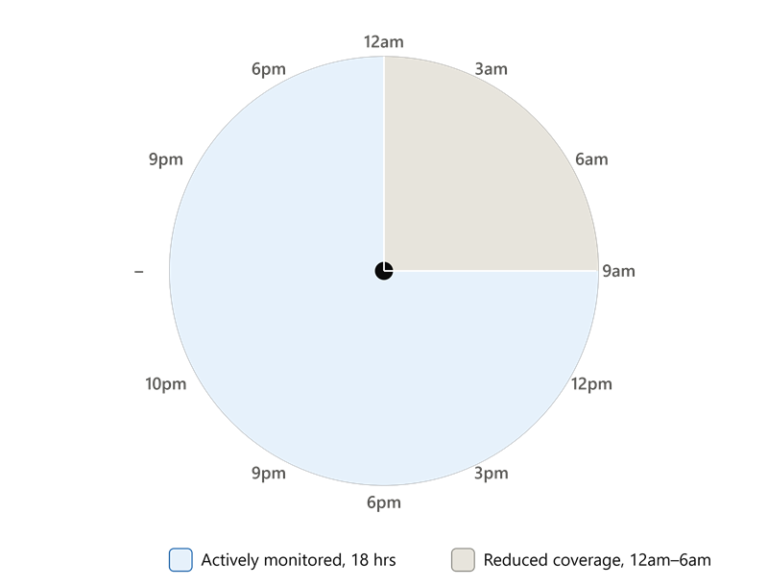
What happens between midnight and 6am specifically, is it the same coverage as during business hours, or a reduced version?
If an alert fires, what is the actual next step, is it a person calling someone, dispatching someone, or just a notification being sent?
Who covers this when the primary person is unavailable, is there a real backup, or does coverage lapse?
What is the actual response time commitment, in writing, not just “prompt” or “immediate”?
Why This Matters More for Some Facilities Than Others
The gap between “monitoring exists” and “monitoring actually protects something” matters most for the failure modes that compound quickly, water intrusion, temperature failures in cold storage, and equipment left running unattended. These are the categories where the difference between a 2am alert being acted on immediately versus discovered the next morning can be the difference between a minor incident and a five-figure loss.
Kibog Response is built specifically to answer all three questions honestly: real people watching continuously, the ability to actually dispatch when something is critical, and coverage that does not depend on one specific person’s schedule. See how it works.
Evaluating a monitoring option and not sure what questions to ask? Talk to our team, we are happy to help you evaluate any option, not just our own.
Explore more: Kibog Response