When facilities managers evaluate sensor monitoring, the connectivity question, cellular or WiFi, often gets treated as a minor technical detail to sort out during setup. It is not a minor detail. It is frequently the difference between a monitoring system that works reliably and one that has a silent failure mode nobody notices until it is too late.
The Problem With Depending on Building WiFi
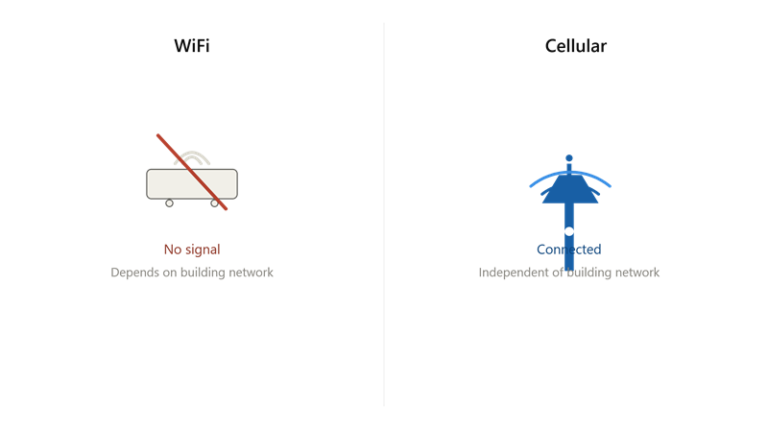
A WiFi-connected sensor is only as reliable as the network it depends on. That creates a specific and common failure pattern: the building’s internet goes down, a router reboot, an ISP outage, a network configuration change made by someone unrelated to facilities, and every sensor connected to that network goes dark at the same time. The monitoring system does not fail loudly. It simply stops reporting, and unless someone is specifically checking for that, the gap in coverage can go unnoticed for exactly as long as the outage lasts.
This is a particularly serious problem for the spaces where monitoring matters most. Mechanical rooms, basements, and rooftop equipment areas are frequently WiFi dead zones even when the rest of a building has strong coverage, meaning the areas with the highest risk of an undetected failure are often the hardest to reliably monitor over WiFi in the first place.
What Cellular Connectivity Actually Solves
A cellular-connected sensor reports over the same mobile networks a phone uses, independent of the building’s own internet or power infrastructure for that specific function. This solves two distinct problems:
It removes the single point of failure. A building’s WiFi going down does not take the monitoring system down with it. The sensors keep reporting regardless of what is happening with the property’s own network.
It works in places WiFi genuinely cannot reach. Basements, rooftop units, remote or unoccupied properties, and spaces with heavy interference or poor signal all become monitorable without needing to extend or troubleshoot the building’s WiFi coverage specifically to accommodate sensors.
This is exactly the setup used in a real vacant property monitoring deployment Kibog built, the property’s own utilities and internet service were inconsistent, which made cellular connectivity not just a preference but a requirement for the monitoring to be trustworthy at all.
When WiFi Is Still the Right Call
Cellular is not automatically the better choice in every case. For a small number of sensors in a well-connected space with reliable building internet, WiFi can be simpler to set up and does not carry the ongoing cost of a cellular data plan. The right choice depends on the specific space: how reliable is the building’s own network, how critical is it that monitoring never has a silent gap, and is the sensor location somewhere WiFi realistically reaches at all.
The Actual Question Worth Asking
Before committing to either option, the real question is not “which is better” in the abstract, it is “what happens to my monitoring if the building’s WiFi goes down for six hours.” If the honest answer is “I would have no idea anything was wrong,” that is a strong signal cellular connectivity is worth the additional cost for at least the highest-risk sensors in your setup.
Not sure which connectivity approach fits your facility? Talk to our team about what your specific spaces actually need — including whether Kibog Response makes sense for actually monitoring and acting on what those sensors detect, once the connectivity question is settled.
Explore more: IoT Solutions