Most commercial coffee machine failures we see in the GTA trace back to one root cause: mineral scale buildup from hard water that was never descaled on schedule. It’s the single most preventable failure category, and also the most commonly ignored, because scale buildup doesn’t cause an obvious symptom until it’s already done real damage.
What Scale Buildup Actually Does
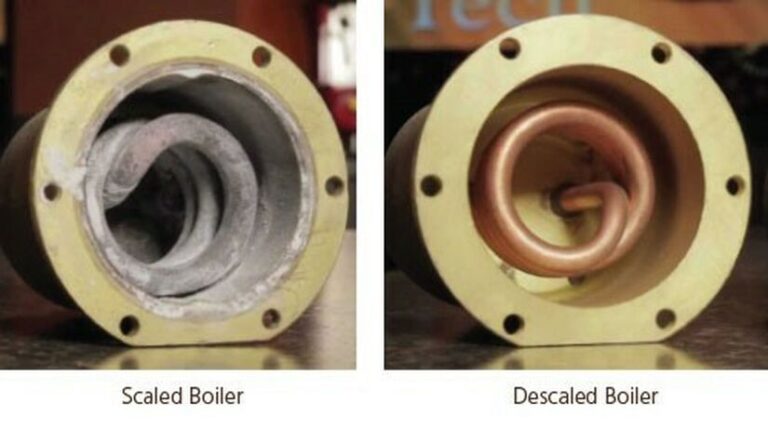
Ontario’s water is moderately hard in most GTA municipalities, which means every brew cycle leaves behind a small amount of mineral deposit inside the machine’s internal lines, heating element, and brew chamber. On its own, one cycle’s worth of scale is meaningless. Over weeks and months without descaling, that buildup restricts water flow through internal lines, causing slower brew cycles and eventually inconsistent output. It coats the heating element, reducing heating efficiency and increasing energy use to reach the same temperature. It creates blockages that lead to leaks, as pressure builds up behind a partially clogged line, and it shortens the working life of pumps and valves, which are not designed to run against scale-restricted flow.
How Often Descaling Actually Needs to Happen
This depends on usage volume and local water hardness, but as a practical guideline for a typical GTA office:
Low-volume machines, under 20 cups a day: every 2 to 3 months.
Moderate-volume machines, 20 to 60 cups a day: monthly.
High-volume machines, 60 or more cups a day, or a shared breakroom serving a large office: every 2 to 4 weeks.
Many commercial machines have a built-in descale indicator, but these are frequently ignored or the light gets dismissed as a minor alert rather than an actual maintenance requirement.
What Happens When It’s Skipped Too Long
The most common repair call we get for scale-related issues isn’t “please descale my machine,” it’s “my machine stopped working entirely.” By the time a machine fully stops, scale has usually already damaged a pump, valve, or heating element that now needs replacement, not just cleaning. A repair that could have been a $0 preventative task becomes a $150 to $400 part replacement.
Doing It Yourself vs. Calling a Technician
Basic descaling on many single-serve and drip machines is something office staff can do with an over-the-counter descaling solution and the manufacturer’s instructions, it’s genuinely not complicated for routine maintenance. Where it’s worth calling a technician instead: the machine hasn’t been descaled in over 6 months and symptoms have already started (slow brewing, inconsistent temperature, unusual noises), internal components need to be checked for existing scale damage before more damage occurs, or the machine model doesn’t have a clear manufacturer descaling procedure available.
If your machine is already showing symptoms, a proper inspection is usually worth more than another round of DIY descaling. Talk to our team about what’s actually happening inside your machine.
Explore more: Coffee Machine Repair, GTA & Hamilton