One of the most common questions facility managers ask when evaluating monitoring for the first time is some version of “how many sensors do I actually need.” There is no universal answer, but there is a practical way to think through it that avoids the two most common mistakes: buying too few to be useful, or buying so many that half of them sit unused.
The Wrong Way to Answer This Question
The wrong approach is starting from a budget number and working backward, “we have $2,000, how many sensors does that buy.” This produces a scattered deployment with no real logic behind sensor placement, often covering low-value spaces because they happened to fit the remaining budget rather than because they genuinely needed monitoring.
The Right Starting Point: Count Your Actual Failure Points
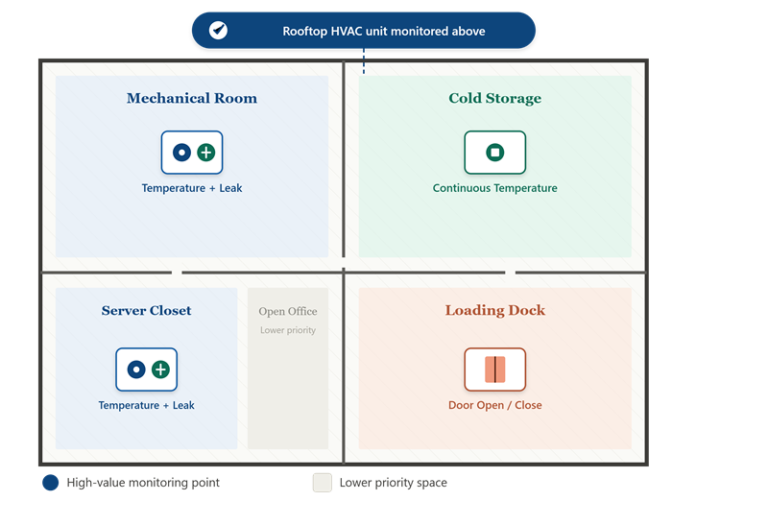
For most commercial buildings, the realistic list of genuinely high-value monitoring points is smaller than people expect. A typical mid-size commercial building might have 1 to 3 mechanical or electrical rooms, 1 to 2 cold storage or refrigeration units if applicable, 1 to 2 server or IT closets, a handful of rooftop or exterior equipment units, and occasional door or access points that matter specifically (loading docks, after-hours entries).
For a facility like this, a realistic starting deployment is often somewhere between 5 and 15 sensors, not the 50 or more that a “monitor everything” instinct might suggest, and not the 1 or 2 that an overly cautious first purchase might produce.
Why More Isn’t Automatically Better
Every sensor added is one more data stream someone needs to have a defined threshold and response plan for. A facility with 40 sensors and no clear plan for what “alert” means at each one produces alert fatigue, so many notifications that the genuinely important ones get lost in the noise. A smaller, well-planned deployment with clear thresholds is more useful than a large, poorly planned one. For guidance on setting up that plan properly, see our IoT monitoring checklist for facility managers.
When It Makes Sense to Scale Up
Once an initial deployment has run for 60 to 90 days, the real data tells you where to expand. A cooler that trended close to its threshold several times but never quite crossed it might warrant a second sensor for redundancy. A space nobody thought was high-risk that had one unexpected incident might get added. This iterative approach consistently produces a better outcome than trying to guess the full deployment upfront.
A Rough Sizing Guide
As a starting reference point, not a hard rule: a small facility, single building, under 20,000 sq ft, typically needs 3 to 6 sensors. A mid-size facility, single building with multiple mechanical or cold storage points, typically needs 8 to 15 sensors. A multi-building or multi-site portfolio should scale per-site using the same logic, rather than one large combined number.
Kibog’s Facility Starter Kit is sized specifically around the small-to-mid-size starting point most facilities actually need, rather than assuming a larger deployment from day one.
Not sure what a realistic sensor count looks like for your specific building? Talk to our team, we’ll walk through your actual spaces, not just sell you a number. Or browse all sensor kits to see how the pre-configured options are built.
Explore more: IoT Solutions