62% of US facility managers were still using spreadsheets or disconnected systems to track their operations as of 2026, and for temperature-sensitive spaces specifically, that often means someone walking a clipboard around twice a day, writing down a number, and hoping nothing goes wrong between readings. This is more common than most people outside facilities management would guess, and it’s worth being honest about what manual logging actually gets you, and what changes when you automate it.
For the full picture of how automated monitoring fits into facility operations broadly, see our IoT Solutions page.
What a Manual Log Actually Tells You
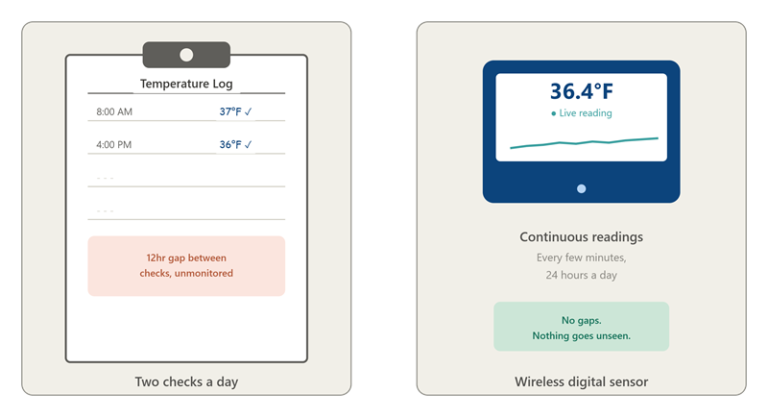
A twice-daily temperature reading tells you the temperature at two specific moments. It tells you nothing about what happened in the 10 or 12 hours in between. If a cooler drifts out of range at 2am and recovers by the time someone checks it at 8am, the manual log shows nothing unusual, even though the contents may have spent six hours outside a safe range.
This is the core limitation, and it’s not a staffing problem. Even a highly diligent employee checking readings exactly on schedule cannot catch what happens between checks. The format itself has a blind spot.
What Changes With Continuous Monitoring
The blind spot closes. A sensor reading every few minutes, 24 hours a day, catches the 2am drift that a twice-daily manual check would completely miss.
Alerts happen in real time, not at the next scheduled check. If a threshold is crossed, the right person is notified immediately, not whenever the next manual reading happens to be scheduled.
Staff time gets returned to actual work. The time spent walking a facility to record readings by hand is time not spent on the tasks that actually require a person’s judgment.
Compliance documentation becomes automatic and defensible. A printed or exportable log with continuous timestamped readings holds up better to a health department or auditor review than a handwritten sheet with two entries a day, and it removes the possibility of a reading being estimated, forgotten, or filled in after the fact.
What Doesn’t Change
Automated monitoring doesn’t remove the need for a human response plan. A sensor that detects a problem at 2am is only useful if someone is actually going to be notified and act on it. The technology closes the detection gap, it doesn’t replace the operational plan for what happens after an alert fires. This is exactly the layer Kibog Response adds on top of the hardware, for facilities that want a real team watching, not just a sensor sending data into the void.
Where This Matters Most
Manual-to-automated conversion delivers the clearest value in spaces where:
- Regulatory or health department compliance requires documented temperature history
- A failure has real financial consequences (inventory spoilage, equipment damage)
- The space isn’t checked frequently enough for a manual log to catch problems in a useful timeframe
Server rooms, walk-in coolers, pharmacy storage, and any space governed by food safety or healthcare compliance requirements are the clearest candidates.
Kibog’s Cold Chain Compliance Kit is built for exactly this transition, continuous monitoring with automatic, exportable logs formatted for the kind of documentation health departments and auditors actually expect to see.
Still keeping a clipboard on the wall? Explore our sensor kits or talk to our team about what a switch to automated monitoring would actually look like for your space.
Explore more: IoT Solutions